
Viome Gut Intelligence test reviews reveal something most people don’t expect.
Most microbiome tests promise the world and deliver a PDF with generic food advice.
Viome? Different story.
But not in all the ways you’d hope.
The Viome Gut Intelligence test costs $299 and claims to analyze your gut microbiome through advanced RNA sequencing.
After analyzing hundreds of user reviews, clinical studies, and real customer experiences, here’s what this test actually delivers.
What Is Viome Gut Intelligence?
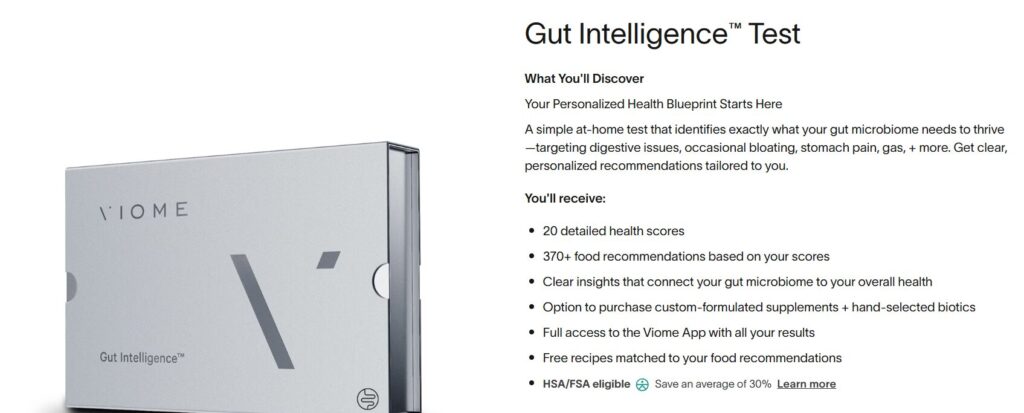
The Viome Gut Intelligence test analyzes your gut microbiome through a stool sample.
You poop on special paper. Collect a sample in a tiny tube. Mail it back. Wait 2-3 weeks for results.
The test uses RNA sequencing (not DNA) to measure what your gut bacteria are actually doing right now.
Not what they could do. What they’re doing.
That’s the first real difference from competitors.
Most tests use DNA sequencing which shows what bacteria are present.
Viome’s RNA approach shows what those bacteria are producing – including potentially harmful compounds like TMAO.
Get the Viome Gut Intelligence Test here
What This Test Actually Measures
Here’s what you get:
20+ health scores covering:
- Gut lining health
- Inflammatory activity
- Protein fermentation levels
- Gas production
- Digestive efficiency
Plus compound analysis:
- TMAO production (linked to heart disease risk)
- Butyrate levels (good for gut lining)
- Hydrogen sulfide (can damage gut barrier)
And the main deliverable:
- Personalized food lists (superfoods, foods to enjoy, foods to avoid)
- Supplement recommendations (which they sell – we’ll talk about that)
The food recommendations are organized into three categories that actually make sense once you understand the data.
The Collection Process (It’s Actually Not That Bad)
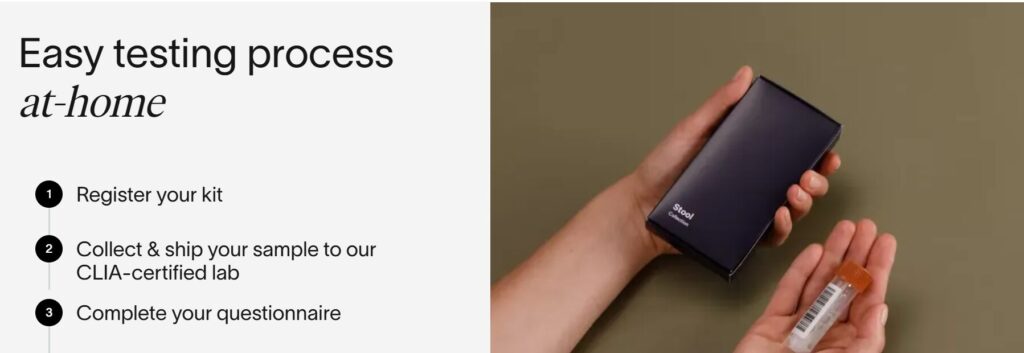
I’ve tested multiple microbiome kits.
Viome has the best collection process.
What’s included:
- Flushable collection paper with sticky edges
- Small sample tube with preservation liquid
- Step-by-step instruction booklet with photos
- Prepaid return shipping box
The paper drapes across your toilet bowl. You do your business. The sticky edges keep it in place.
Then you use the little scoop attached to the tube cap to grab a sample. Drop it in the tube. Shake it up. Box it up. Done.
Time required: 5 minutes max
Difficulty level: If you’ve changed diapers you can do this
The only tricky part? Landing the stool on the paper without it sliding off.
Took me two tries.
Not gonna lie.
What My Results Actually Showed
I got my results 18 days after shipping the sample.
The good stuff:
My microbiome was overproducing TMA – the precursor to TMAO.
Why does this matter?
TMAO is linked to increased cardiovascular risk in multiple studies including research published in the New England Journal of Medicine.
High TMAO means I needed to cut back on:
- Red meat
- Eggs
- Certain fish
This was genuinely useful information I wouldn’t have known otherwise.
The questionable stuff:
Viome told me to avoid barley because the gliadin protein might irritate my gut lining.
The study they cited showed that gliadin increases intestinal permeability in everyone – not just celiacs.
But here’s the problem:
The recommendation was generic. Not personalized to my actual zonulin levels. Not based on any inflammation markers in my specific results.
I followed up with actual blood testing through Quest Diagnostics.
My tissue transglutaminase markers (TtG IgA and IgG) were completely normal. My TMAO blood levels came back at 6.1 uM – healthy range.
So either:
- Viome was right and my microbiome improved
- The predictions were overstated
Can’t say for sure.
The weird stuff:
Viome flagged bell peppers and tomatoes as foods to avoid.
Reason?
A plant virus commonly found in these foods showed up in my microbiome.
They call this the “virome.”
No virus name provided. No research cited. Just “avoid these for 30 days.”
This felt like pseudoscience dressed up as cutting-edge tech.
The User Interface and Experience
Desktop version: 8/10
Clean layout. Easy navigation. Food lists organized clearly by category. You can search specific foods. Download PDFs of everything.
Mobile app: 5/10
Clunky. Harder to navigate. Same information but worse organization.
Stick with desktop if you have the option.
The initial questionnaire:
Viome asks extensive health questions during setup:
- Digestive symptoms
- Sleep patterns
- Stress levels
- Exercise habits
- Medical history
Takes 15-20 minutes.
Here’s the catch:
Most questions have zero connection to your actual test results.
They ask about sleep quality. Stress levels. Mental health.
But your results don’t reference any of this.
It feels like data mining more than personalization.
The Supplement Upsell (Let’s Talk About It)
Here’s where things get interesting.
Viome sells a subscription supplement program:
- Custom probiotic blend
- Custom prebiotic blend
- Precision supplements (omega-3s, etc.)
The pitch:
Subscribe for 3 months minimum at $79.95/month. Get the Gut Intelligence test for free (normally $299).
The math:
3 months of supplements = $239.85 Regular test price = $299 Total if you subscribe = $239.85 Savings = $59.15
But only if you were going to buy supplements anyway.
My take:
The upsell is aggressive but not dishonest.
The results page constantly prompts you to add supplements to your cart. Multiple CTAs throughout the interface. Email follow-ups pushing the subscription.
I get it – test kit companies need to make money somewhere.
Profit margins on tests are razor-thin.
But it does color the experience.
Makes you wonder: Are the food restrictions designed to push supplements?
I don’t have proof either way.
Just something to consider.
Viome Gut Intelligence vs Full Body Intelligence
Viome offers two main tests:
Gut Intelligence ($299):
- Stool sample only
- Focus on digestive health
- 20+ gut health scores
- Food and supplement recommendations
Full Body Intelligence ($599):
- Stool sample + blood sample
- Adds cellular health analysis
- Biological age estimation
- Mitochondrial health scores
- More comprehensive food lists
The Full Body test doubles the price for systemic health data.
Worth it?
Check out my full Viome reviews here for a detailed comparison.
For most people starting out, the Gut Intelligence test is enough.
You get the core microbiome analysis. The food recommendations. The TMAO screening.
The Full Body test makes sense if:
- You have chronic fatigue or systemic symptoms
- You want biological age tracking
- Budget isn’t a concern
Otherwise? Start with Gut Intelligence.
Real User Experiences (The Good and Bad)
I dug through hundreds of user reviews.
What people loved:
“Lost 15 pounds in 2 months just following the food lists” – Tina
“My sleep improved dramatically after week one” – Jess
“Finally identified foods that were causing my bloating” – Beth
“Lost 23 pounds that haunted me for 10 years” – Suzanna
Common themes in positive reviews:
- Weight loss without traditional dieting
- Improved energy levels
- Better sleep quality
- Reduced digestive symptoms
- Clearer skin
What people complained about:
- Price ($299 is steep for many)
- Aggressive supplement marketing
- Results felt generic despite “personalization”
- Some recommended “superfoods” were already on their avoid list from food sensitivities
- Conflicting information between retests
The split is roughly 70/30 positive to negative based on Amazon and independent review sites.
Most negative reviews center on price and the supplement push.
Not the actual science or results quality.
Accuracy and Scientific Validity
Let’s be honest about what we know and don’t know.
What Viome gets right:
RNA sequencing is more advanced than DNA sequencing for microbiome analysis. It measures active gene expression, not just bacterial presence. The TMAO connection to cardiovascular health is supported by peer-reviewed research. The company publishes some of their research methodologies.
What’s still unclear:
Microbiome science is young – like really young. We don’t have decades of longitudinal data. Individual recommendations are based on population averages, not just your unique biology. The virome analysis appears to be cutting-edge but lacks published validation studies.
My follow-up testing:
I did blood work through Quest Diagnostics to verify Viome’s TMAO warning.
Results: Mixed
My TMAO blood levels were healthy despite Viome flagging high production.
Either:
- My body processes TMA efficiently before it converts to TMAO
- My diet changes between tests affected results
- The stool-based prediction doesn’t perfectly correlate with blood levels
I’m not saying Viome was wrong.
I’m saying the picture is more complex than a single test can show.
Expert perspectives:
Dr. Tom Dayspring (nationally recognized lipid expert) has stated that TMAO “isn’t ready for primetime” as a core cardiovascular biomarker.
More research is needed.
But the signal is real enough to pay attention to.
What The Test Misses
Zonulin levels:
Viome warns about gut permeability from gliadin. But doesn’t measure actual zonulin levels.
You’re making dietary changes based on potential risk, not confirmed damage.
Taxonomy data:
Most microbiome tests show you the specific bacteria strains in your gut.
Viome keeps this behind the curtain.
You get functional outputs (what bacteria are doing) but not the bacterial census.
This matters if you want to compare results across different testing platforms or track specific strains over time.
Actual inflammation markers:
Viome predicts inflammatory activity. But doesn’t measure C-reactive protein, calprotectin, or other direct inflammation markers.
For that you need blood or additional stool testing.
Who Should Take This Test
Good fit if you:
- Have unexplained digestive issues (bloating, irregular bowel movements, gas)
- Want to optimize diet beyond generic nutrition advice
- Are comfortable with $299 for health insights
- Don’t mind some uncertainty in recommendations
- Like data-driven approaches to wellness
Bad fit if you:
- Need a diagnosis for a specific condition (this isn’t diagnostic)
- Want extremely detailed bacterial taxonomy
- Expect perfect accuracy with immediate results
- Can’t afford both the test and potential dietary changes
- Are looking for a medical-grade diagnostic tool
Skip this test if:
- You have severe GI symptoms that need medical evaluation first
- You’re looking for celiac disease testing (get actual antibody tests)
- You want insurance-covered testing (Viome doesn’t accept insurance)
Viome Gut Intelligence Pros and Cons
Pros:
- RNA sequencing provides functional data, not just bacterial presence
- Excellent user experience and collection process
- TMAO screening adds real cardiovascular insight
- Food lists are organized clearly and searchable
- Can identify specific gut irritants you might not suspect
- Regular updates to recommendations as science evolves
Cons:
- $299 price point is high for a single test
- Aggressive supplement upselling throughout the experience
- Some recommendations feel generic despite personalization claims
- Virome analysis lacks transparent validation
- No taxonomy data provided
- Results need context from additional testing for full picture
Is Viome Gut Intelligence Worth It?
Depends what you’re comparing it to.
Worth it compared to:
- Guessing which foods bother you (yes)
- Generic elimination diets (yes)
- Nothing at all (probably yes)
Not worth it compared to:
- Working with a functional medicine doctor who orders comprehensive testing (no)
- Spending $299 on high-quality food (debatable)
My honest take:
If you have $299 to spend on health optimization and digestive issues that aren’t severe, Viome provides value.
The TMAO screening alone could be worth it for heart health.
The food lists, while not perfect, give you a starting point for elimination testing.
But set realistic expectations.
This isn’t going to solve serious GI disease. It won’t replace medical care. Some recommendations will feel like educated guesses.
And you will get pushed to buy supplements.
Hard.
Who gets the most value:
People who:
- Are already health-conscious
- Have tried basic interventions without success
- Want data to guide next steps
- Can afford to experiment with dietary changes
Who should skip it:
People who:
- Need medical diagnosis
- Can’t afford the test without financial stress
- Expect one test to solve everything
- Aren’t willing to actually change their diet based on results
For a more detailed breakdown of Viome pricing, accuracy, and whether it’s worth it, see my Viome reviews here.
How To Get Started With Viome Gut Intelligence
If you decide to try it:
Step 1: Order directly from Viome Get the test here
Step 2: Register your kit online immediately when it arrives Don’t wait – the sample preservation matters
Step 3: Collect sample in the morning if possible Some practitioners believe morning samples are more consistent
Step 4: Ship same day or next day Don’t let it sit around
Step 5: Wait 2-3 weeks for results Set a reminder to check
Step 6: Download all PDFs when results arrive Save everything before your subscription period ends if you don’t continue
Step 7: Consider follow-up blood testing Verify TMAO and inflammation markers if flagged
Step 8: Implement changes gradually Don’t overhaul your entire diet overnight
Step 9: Track symptoms Keep notes on what changes and when
Step 10: Retest in 3-6 months if making significant changes See if interventions are working
Final Verdict on Viome Gut Intelligence
The Viome Gut Intelligence test delivers on some promises and oversells others.
What it does well:
- Identifies TMAO production risk
- Flags potential gut irritants
- Provides actionable food lists
- Uses more advanced testing technology than most competitors
What it could improve:
- Tone down the supplement push
- Provide more granular bacterial data
- Better integrate questionnaire data with results
- More transparent about limitations and uncertainty
Bottom line:
Worth the $299 if you’re serious about gut health optimization and can afford it without stress.
Not worth it if you’re looking for a diagnostic tool or expecting perfect accuracy.
The test gives you a data point. Not the whole picture.
Use it as one input among many.
Not the final word on your health.
For the full breakdown comparing Gut Intelligence to Full Body Intelligence and other microbiome tests, check out my complete Viome review.
Frequently Asked Questions About Viome Gut Intelligence
How accurate is the Viome Gut Intelligence test?
Viome uses RNA sequencing which is more advanced than DNA-based tests, but microbiome science is still developing. My follow-up blood testing showed mixed correlation with Viome’s predictions. Use results as guidance, not gospel.
Does insurance cover Viome testing?
No. Viome doesn’t accept insurance. You pay out of pocket. Some HSA/FSA accounts may reimburse – check with your provider.
How long do Viome results take?
2-3 weeks from when they receive your sample. Processing time can vary slightly during busy periods.
Can I take Viome if I’m on antibiotics?
Wait at least 4 weeks after finishing antibiotics. They dramatically alter your microbiome. Testing during or right after will give inaccurate results.
Do I need to buy Viome supplements?
No. The supplements are optional. You get full test results and food recommendations without buying anything else. But they will push hard.
How often should I retest with Viome?
Viome recommends every 3-6 months if making diet changes. Realistically? Once a year is probably enough for most people unless you have significant symptoms.
Is Viome FDA approved?
No. Viome is a wellness test, not a diagnostic medical device. It’s not intended to diagnose, treat, or cure any disease. Use it for optimization, not diagnosis.
Can Viome detect SIBO or parasites?
No. Viome analyzes microbiome function, not specific pathogens. For SIBO testing you need a breath test. For parasites you need a comprehensive stool test with microscopy.
Will Viome show food allergies?
No. Viome doesn’t test for IgE-mediated allergies. It shows foods that may irritate your gut based on microbial activity. Different thing entirely.
Can I use Viome results with my doctor?
You can share them, but many conventional doctors aren’t trained in microbiome interpretation. Functional medicine practitioners are more likely to incorporate the data.
What’s the difference between Gut Intelligence and Full Body Intelligence?
Gut Intelligence uses stool sample only and focuses on digestive health. Full Body adds blood testing for cellular health, biological age, and mitochondrial function. Price doubles from $299 to $599.
Does Viome work for IBS?
Many users report improvement in IBS symptoms, but Viome isn’t designed to diagnose or treat IBS. It may help identify trigger foods that worsen symptoms.
Can I cancel Viome subscription anytime?
If you bought the test standalone, there’s no subscription to cancel. If you got the test through their supplement subscription, you commit to 3 months minimum.
How does Viome compare to Thorne, Ombre, or Viome competitors?
Viome uses RNA sequencing while most competitors use DNA sequencing. This provides functional data about what bacteria are doing, not just what’s present. For detailed comparisons, see my main Viome reviews page.
Is the Viome app necessary?
No. The desktop interface is actually better. You can access everything through their website. The app is optional and honestly not great.
What if my results contradict what I know about my body?
Trust your body first. Viome results are predictions based on population data. If a “superfood” makes you feel terrible, don’t eat it. Use results as suggestions, not commands.