If you’re looking for the best sauerkraut for gut health, you’re probably tired of feeling bloated, dealing with digestive issues, or just wanting to fix your gut once and for all.
I get it.
You’ve heard fermented foods are good for you.
You’ve seen the influencers drinking kombucha and eating kimchi.
But here’s the thing nobody tells you: most sauerkraut at the grocery store is basically useless for gut health.
Yeah, I said it.
Because that jar sitting on the shelf next to the hot dogs?
Dead bacteria.
Zero probiotics.
Just pickled cabbage.
So in this guide, I’m going to show you exactly which sauerkraut brands actually contain live probiotics, how to spot the fake stuff, and how much you need to eat to actually see results.
No BS.
No fluff.
Just what works.
Why Most Sauerkraut Is a Waste of Money
Here’s what the food industry doesn’t want you to know.
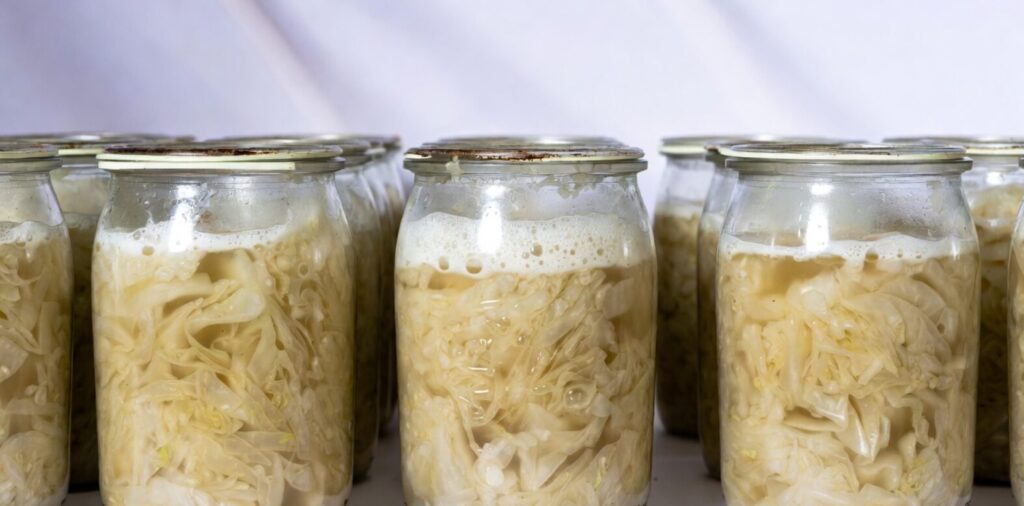
Real sauerkraut is made through lacto-fermentation.
That means you take cabbage, add salt, let natural bacteria do their thing for weeks, and boom – you get live probiotics.
But that takes time.
Time costs money.
So what do most companies do?
They pasteurize it.
Pasteurization kills bacteria – including the good bacteria you’re buying it for.
Or they add vinegar and sugar to make it taste “fermented” without actually fermenting it.
The result?
You’re buying expensive pickled cabbage with zero gut health benefits.
That’s why knowing what to look for matters.
What Makes Sauerkraut Actually Good for Your Gut
Let me break this down super simple.
Your gut has about 100 trillion microbes living in it.
These microbes impact everything – digestion, mood, immune system, even your skin.
When you eat real fermented sauerkraut, you’re adding beneficial bacteria to this ecosystem.
Specifically, you’re getting Lactobacillus bacteria.
Lactobacillus plantarum and Lactobacillus brevis to be exact.
These strains do three main things:
- They protect your intestinal lining from bad bacteria and toxins
- They help balance the good and bad microbes in your gut
- They produce short-chain fatty acids that reduce inflammation
Plus, sauerkraut gives you 4 grams of fiber per cup.
Fiber feeds your good bacteria and keeps things moving.
But here’s the kicker – you only get these benefits if the bacteria are alive when you eat it.
That’s why the type of sauerkraut you buy matters so much.
How to Spot Real Probiotic Sauerkraut (The 3-Step Test)
Okay, so you’re at the store.
You’re staring at the sauerkraut section.
How do you know which one actually has probiotics?
Follow these three steps:
Step 1: Look in the Refrigerated Section
If it’s sitting on a shelf at room temperature, skip it.
Real probiotic sauerkraut needs to stay cold because the bacteria are alive.
Now, not all refrigerated sauerkraut has probiotics.
But this step eliminates 90% of the garbage right off the bat.
Step 2: Check the Label for Keywords
Look for these exact words:
- “Raw”
- “Unpasteurized”
- “Contains live active cultures”
- “Probiotic”
- “Live”
If you see any of these, you’re on the right track.
But you’re not done yet.
Step 3: Read the Ingredients List
This is where most people mess up.
The ingredients should be:
- Cabbage
- Salt
- Maybe some other vegetables or spices
That’s it.
If you see any of these ingredients, put it back:
- Vinegar (any kind)
- Sugar (any kind)
- Sodium benzoate
- Sodium bisulfate
- Lactic acid (as a preservative)
- Food dyes
These ingredients either prevent fermentation or kill the probiotics.
They’re there to make production cheaper and increase shelf life – not to help your gut.
The Best Sauerkraut Brands for Gut Health (That I’ve Found)
Alright, let’s get to what you actually came here for.
These are the brands that actually deliver on probiotics.
I haven’t used all of these personally, but they all pass the 3-step test above.
Top Organic Options
If you want organic (less pesticides, better for the environment), these are your best bets:
Olive My Pickle Top Kraut Bundle
This is a 3-pack with different flavors – Carrot & Dill, Red & Ginger, and Classic Caraway.
Lab verified to have 14 billion CFU of lactobacillus per serving.
That’s a real number, not marketing fluff.
Made in Jacksonville, Florida by a small family business.
Comes in resealable pouches which is clutch for keeping it fresh.
Raw, unpasteurized, no weird ingredients.
Solid option at Whole Foods and natural food stores.
Multiple flavors – raw organic kraut, dill & garlic, red beet & cabbage.
Clean ingredients.
Widely available which makes it convenient.
Pickled Planet Organic Sauerkraut
They’ve got like 10 different varieties.
Great Plain, Dill, Sea Vegetable, Basil Garlic, Beat Kraut, I-Boost Herbal Kraut, Veda Kraut.
All organic, all raw, all probiotic-rich.
If you like variety, this is your brand.
Real Pickles Organic Sauerkraut
East coast favorite.
They do classic, garlic kraut, turmeric kraut, and red cabbage.
Available at Whole Foods and Stop & Shop in some areas.
High quality stuff.
Hamptons Brine Organic Sauerkraut
Kraut-N-Kale, Cabbage, Beets & Jalapenos, Carrots & Cabbage.
All organic and raw.
Good flavor combos if you want something different.
Best Non-Organic Options
If organic isn’t a priority or you’re on a budget, these work too:
This is the most widely available option.
You can find it at almost any grocery store.
It’s not technically “raw” because it’s partially pasteurized.
But it still contains probiotics.
Good entry point if you’re just starting out.
Classic Caraway, Roasted Garlic, Whiskey Dill, Beet Red, Gnar Gnar (with peppers and chilis).
All raw and unpasteurized.
Really good flavors.
Slightly cheaper than some organic options.
Dill & Garlic, Bavaria, Sriracha, Naturally Raw Curtido.
Not artisanal but it’s affordable and does the job.
Good if you’re going through a lot of sauerkraut and don’t want to spend a fortune.
Amish Wedding Old Fashioned Sauerkraut
Usually only available online.
Traditional recipe, raw, unpasteurized.
Worth checking out if you want something old-school.
How Much Sauerkraut Should You Actually Eat?
Okay, so you bought the right stuff.
Now what?
How much do you need to eat to actually see benefits?
Here’s what the research shows:
One study had people eat six 6-ounce servings of fermented foods per day.
That’s about 4.5 cups of sauerkraut daily if you did just sauerkraut.
Which is insane.
Nobody’s eating that much.
Plus, they mixed it up – yogurt, kimchi, sauerkraut, etc.
So what’s realistic?
Start Small: 1 Teaspoon to 1/4 Cup
If you’re new to fermented foods, start with a teaspoon.
Literally just a teaspoon with a meal.
Why?
Because jumping straight to a cup of sauerkraut can cause bloating, gas, and digestive discomfort.
Your gut needs time to adjust.
After a few days, bump it up to 1/4 cup.
See how you feel.
Maintenance Dose: 1/8 to 1/2 Cup Per Day
Once your gut adjusts, aim for 1/8 to 1/2 cup per day.
That’s the sweet spot for most people.
You can have it with meals or as a snack.
Some people do better with smaller amounts multiple times a day.
Others prefer one bigger serving.
Test what works for you.
When to Eat It
Honestly, it doesn’t matter that much.
Some people swear by eating it on an empty stomach.
Others prefer it with food.
The research says eating it within 30 minutes of a meal helps it travel deeper into your gut with the food.
But realistically, just eat it whenever it fits your schedule.
Consistency matters more than timing.
What to Watch Out For (Side Effects & Warnings)

Sauerkraut isn’t for everyone.
Here’s what you need to know:
Bloating and Gas
This is the most common side effect.
It usually happens when you eat too much too fast.
Solution?
Start smaller and ramp up slowly over 2-4 weeks.
High Sodium
Sauerkraut is salty.
Really salty.
If you have high blood pressure, kidney issues, or are on a low-sodium diet, you need to be careful.
Talk to your doctor first.
Histamine and Tyramine Issues
Fermented foods contain histamine and tyramine.
If you’re on a low histamine diet or taking MAOIs (a type of antidepressant), sauerkraut might cause problems.
Symptoms can include headaches, flushing, or digestive distress.
Again, check with your doctor.
FODMAP Sensitivity
If you have IBS or SIBO, white cabbage sauerkraut is high FODMAP.
High FODMAP foods can trigger symptoms like bloating, gas, and diarrhea.
But here’s the hack: red cabbage sauerkraut is low FODMAP in servings up to 1/2 cup (drained).
So if regular sauerkraut bothers you, try red cabbage versions.
How to Actually Eat Sauerkraut (Without Hating It)
Let’s be real.
Sauerkraut isn’t the most exciting food.
But it doesn’t have to be boring.
Here are some ways to make it work:
- On sandwiches or wraps – adds crunch and tang
- On top of salads – replaces dressing with flavor
- Mixed into grain bowls – pairs well with rice, quinoa, or farro
- On burgers or hot dogs – classic combo
- With eggs – surprisingly good at breakfast
- Straight from the jar – if you’re hardcore
- In smoothies – yes, really (just a small amount)
Important: Never cook sauerkraut if you want the probiotic benefits.
Heat kills the bacteria.
Always eat it cold or at room temperature.
Does Organic Actually Matter?
Short answer: not as much as you think.
Organic is better for reducing pesticide exposure and supporting sustainable farming.
But it doesn’t necessarily mean more probiotics.
The middle of the cabbage (where the good stuff is) doesn’t get directly sprayed with chemicals anyway.
It’s mostly the outer leaves.
So if budget is tight, non-organic raw sauerkraut is still way better than pasteurized organic sauerkraut.
Prioritize raw and unpasteurized over organic.
Should You Make Your Own Sauerkraut?
Making your own sauerkraut is way cheaper.
A head of cabbage costs like $2.
That makes about 4-6 jars worth of sauerkraut.
Versus $8-12 per jar at the store.
So if you’re eating a lot of it, DIY makes financial sense.
But it takes time.
You need to shred cabbage, mix it with salt, pack it in jars, wait 3-4 weeks for fermentation, and monitor it.
For most people, the convenience of buying it ready-made is worth the premium.
But if you’re interested, it’s not hard to learn.
Just Google “how to make sauerkraut” and follow a basic recipe.
Brands to Avoid (The Ones That Don’t Work)
Now let me tell you what NOT to buy.
Frank’s Kraut
No probiotics.
Pasteurized.
Claussen Sauerkraut
Contains sodium benzoate and sodium metabisulfite.
These preservatives kill probiotics.
Plus, sodium benzoate can form benzene (a carcinogen) when combined with vitamin C.
Eden Foods Sauerkraut
It’s “hot packed” which kills most of the probiotics.
Not worth it.
Any canned sauerkraut
Canned = cooked = no probiotics.
End of story.
Anything on a non-refrigerated shelf
If it doesn’t need to be cold, it doesn’t have live bacteria.
FAQ: Your Questions Answered
Can you eat too much sauerkraut?
Yes.
Too much of anything is bad.
Sauerkraut is high in sodium, histamine, and FODMAPs.
Eating excessive amounts can cause bloating, gas, diarrhea, or upset stomach.
Stick to 1/8 to 1/2 cup per day for most people.
Does sauerkraut make you poop?
It can help with regularity thanks to the fiber and probiotics.
But it won’t make you poop immediately unless you have a severe intolerance to cabbage.
Over time, it can improve bowel movements.
Can sauerkraut cause diarrhea?
If you eat too much too fast, yes.
If you have IBS or SIBO and eat white cabbage sauerkraut (high FODMAP), yes.
Start small and see how your body reacts.
Is sauerkraut a prebiotic or probiotic?
It’s both.
All sauerkraut contains prebiotics (fiber that feeds good bacteria).
But only raw, unpasteurized sauerkraut contains probiotics (live bacteria).
Should you eat sauerkraut on an empty stomach?
You can, but you don’t have to.
Some people prefer it that way.
Others find it easier to digest with food.
Do whatever feels better for you.
Is sauerkraut good for IBS?
It depends.
White cabbage sauerkraut is high FODMAP and can trigger IBS symptoms.
Red cabbage sauerkraut is low FODMAP (up to 1/2 cup drained) and may be better tolerated.
Work with a dietitian to figure out what works for you.
How long does sauerkraut last in the fridge?
Unopened, it can last several months past the date on the label.
Once opened, it stays good for 4-6 months if kept refrigerated.
The probiotics stay active the whole time.
Can pregnant women eat sauerkraut?
Generally yes, but check with your doctor.
Raw fermented foods carry a small risk of foodborne illness.
Some doctors recommend avoiding unpasteurized foods during pregnancy.
Is all fermented food probiotic?
No.
All probiotic foods are fermented, but not all fermented foods are probiotic.
Fermented foods may contain vinegar, preservatives, or be pasteurized – which kills probiotics.
Only raw, unpasteurized fermented foods without vinegar or preservatives are probiotic.
What’s the difference between sauerkraut and kimchi for gut health?
Both are fermented cabbage with probiotics.
Kimchi typically has more variety of vegetables and spices, so it may have slightly more diverse bacterial strains.
But both work great for gut health if they’re raw and unpasteurized.
Choose based on taste preference.
Can you take probiotics and eat sauerkraut at the same time?
Yes, absolutely.
They work synergistically.
Probiotic supplements provide specific strains in controlled amounts.
Sauerkraut provides a diversity of strains plus fiber to feed them.
Combining both can be beneficial.
Does sauerkraut help with weight loss?
Indirectly, yes.
A healthy gut microbiome is linked to better metabolism and weight regulation.
Sauerkraut’s probiotics and fiber support gut health.
But it’s not a magic weight loss food.
It’s one piece of the puzzle.
Can kids eat sauerkraut?
Yes, but start with very small amounts.
Kids’ taste buds may find it too sour at first.
Mix a tiny bit into foods they already like.
Avoid if they have digestive conditions without consulting a pediatrician.
Why does my sauerkraut have white stuff on top?
That’s kahm yeast.
It’s harmless but indicates exposure to air.
Just scrape it off and eat the sauerkraut underneath.
It won’t hurt you but it can affect taste.
Can I freeze sauerkraut?
You can, but freezing kills most of the probiotics.
The fiber benefits remain, but you lose the live bacteria.
If you’re freezing it, you might as well buy pasteurized (cheaper).
Only freeze if you’re using it for flavor, not gut health.
The Bottom Line: Best Sauerkraut for Gut Health
Here’s what you need to remember:
Most store-bought sauerkraut is worthless for gut health because it’s pasteurized.
The best sauerkraut for gut health is raw, unpasteurized, and made with just cabbage, salt, and maybe other vegetables.
Look for keywords like “raw,” “unpasteurized,” “live cultures,” or “probiotic” on the label.
Avoid anything with vinegar, sugar, or preservatives like sodium benzoate.
Start with 1 teaspoon and work up to 1/8 to 1/2 cup per day.
Top brands include Olive My Pickle, Wildbrine, Pickled Planet, Real Pickles, Bubbies, and Cleveland Kraut.
Organic is nice but not essential – prioritize raw over organic.
Watch out for side effects if you have IBS, high blood pressure, or histamine issues.
Never cook sauerkraut if you want the probiotic benefits.
The best sauerkraut for gut health is the one you’ll actually eat consistently.
Pick a brand that tastes good to you, fits your budget, and meets the three criteria: refrigerated, labeled as raw/unpasteurized, and clean ingredients.
Your gut will thank you.